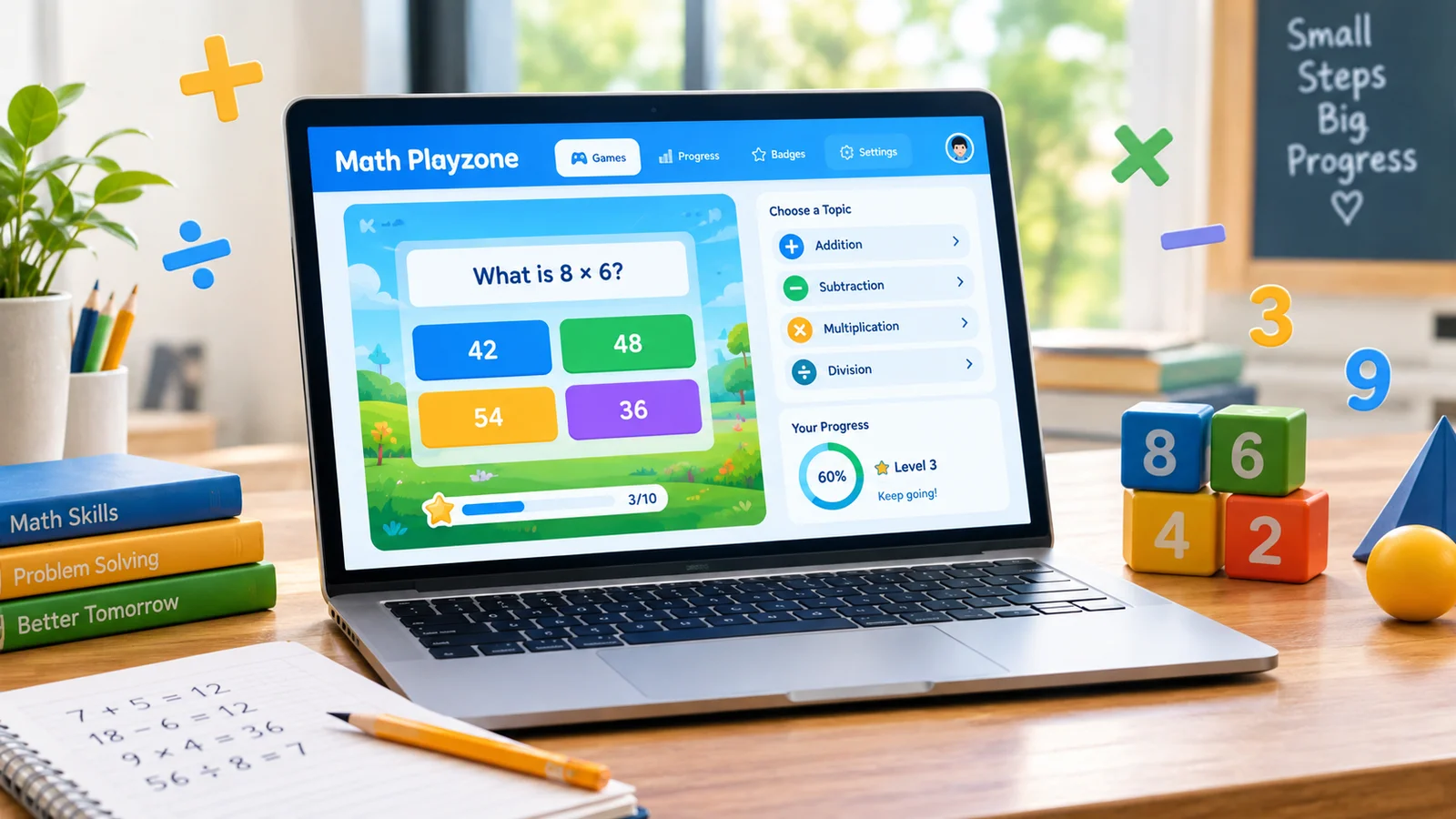
Learning math does not need to feel hard or boring. Math Playzone brings learning and play together in one simple idea. It gives children a fun way to practice numbers and basic math skills. Instead of only reading lessons, learners can solve problems through games and activities. This style can make practice feel less stressful. Children may work on addition, subtraction, multiplication, division, and logic skills. They can also learn from mistakes and try a problem again. Parents and teachers can use playful math activities as extra practice alongside regular lessons. The goal is not just getting answers right. It is also about understanding how numbers work. In this guide, we explain the idea behind playful math learning, its possible benefits, useful activity types, and smart ways to build better study habits.
Math Playzone Overview
The table below gives a quick overview of Math Playzone as a math-learning concept. Since it is not a person, a traditional biography table would not fit this topic. A learning profile is more useful and accurate.
| Detail | Information |
| Main Topic | Math learning and practice |
| Learning Style | Interactive and game-based |
| Common Audience | Children, students, parents, and teachers |
| Core Skills | Addition, subtraction, multiplication, and division |
| Other Skills | Logic, patterns, counting, and problem-solving |
| Activity Types | Games, puzzles, quizzes, and practice questions |
| Learning Goal | Make math easier to understand and practice |
| Difficulty | Can range from basic to more challenging |
| Best Use | Extra practice and skill review |
| Parent Role | Guide, encourage, and monitor progress |
| Teacher Role | Add activities to regular classroom learning |
| Key Benefit | Combines practice with enjoyable activities |
What Is Math Playzone?
Math Playzone can be understood as a playful learning space focused on mathematics. The main idea is simple. Students learn by solving problems in an active way. They may answer questions, complete number puzzles, spot patterns, or play educational games. This approach is different from reading a long page of formulas. A learner gets a task and must think about the answer. That active process can make practice more interesting. It may also help students see math as a useful skill instead of only schoolwork. However, games should support real learning goals. A colorful activity has little value when it does not teach useful skills. Parents and teachers should therefore choose activities that match the learner’s age, current ability, and school lessons.
Why Play Can Make Math More Interesting
Many children enjoy games because games give them a clear goal. They can complete a level, solve a puzzle, or improve a previous result. Math Playzone uses the same basic idea for educational practice. A simple number challenge can feel less demanding than a long worksheet. This may encourage a learner to spend more time practicing. Repeated practice matters because math skills often improve through regular use. A child who practices addition often may become quicker at recognizing number relationships. Games can also provide small challenges that keep the mind active. Still, fun should not replace understanding. A student should know why an answer is correct. Adults can ask children to explain their thinking after an activity. This turns simple gameplay into a stronger learning experience.
Skills Children Can Practice
A good Math Playzone experience can cover several important math skills. Younger children may begin with counting and number recognition. They can then move toward addition and subtraction. Older learners may practice multiplication, division, fractions, shapes, measurements, and simple problem-solving. Logic games can also help children think carefully before choosing an answer. Pattern activities may improve their ability to notice relationships between numbers. Word problems are useful because they connect mathematics with daily situations. For example, a child may calculate the total cost of three toys. Another activity might ask how many pieces remain after sharing food. These small examples show that mathematics is part of normal life. The best activities focus on understanding instead of only speed. Accuracy and clear thinking should come before fast answers.
Addition and Subtraction Practice
Addition and subtraction are important building blocks for later mathematics. Math Playzone activities can make these skills easier to practice through short challenges. A child might add groups of objects, complete missing numbers, or solve a simple number puzzle. Subtraction activities can use everyday examples. Imagine having ten apples and giving three away. The learner must work out how many remain. Visual examples can be especially helpful for younger students because they connect numbers with real objects. As confidence grows, learners can move from pictures to written number problems. They can also practice mental math with smaller numbers. Parents should avoid pushing children to answer too quickly. First, help them understand the process. Speed often improves naturally after the child becomes comfortable with the skill.
Multiplication and Division Activities
Multiplication can seem difficult when children first see large groups of numbers. Game-based practice can make it easier to understand. Math Playzone may be used as a framework for practicing times tables through matching games, quick questions, and number patterns. Instead of memorizing every fact without context, learners can see multiplication as repeated addition. For example, three groups of four make twelve. Division can then be explained as sharing or grouping. Twelve objects shared between three children gives each child four. Simple examples like these make abstract ideas easier to understand. After learning the concept, students can practice facts until they become familiar. A healthy learning routine combines explanation, examples, and repeated practice. This approach builds understanding while also improving recall.
Math Puzzles and Logic Games
Math is about more than calculations. It also involves thinking, planning, and finding patterns. Logic puzzles can therefore be a valuable part of Math Playzone learning. A puzzle might ask students to find the missing number in a sequence. Another could require arranging shapes according to a rule. These activities encourage learners to slow down and look for clues. Children may discover that one problem can sometimes be solved in different ways. That is an important lesson because strong problem-solving is about choosing useful strategies. Adults can improve the activity by asking simple questions. “How did you find that answer?” is often more helpful than only saying whether the answer is correct. Explaining a solution helps a child organize thoughts and identify mistakes.
How Math Games Support Problem-Solving
Problem-solving develops when students face questions that require more than memorized facts. Math Playzone activities can introduce small challenges in a friendly setting. Suppose a learner has 20 coins and wants to buy four equal items. The child needs to decide how much can be spent on each item. This combines division with practical thinking. Another challenge could involve finding the shortest route on a grid. Such tasks encourage planning and testing ideas. When an answer is wrong, the learner can study the mistake and try another method. That process matters because mistakes can reveal where understanding is weak. Parents and teachers should treat wrong answers as learning opportunities. Asking a child to explain each step can often reveal exactly where confusion started.
Using Math Playzone at Home
Parents can build a simple Math Playzone routine without turning home into another classroom. Short practice sessions often work better than long, tiring ones. A child could spend some time on a math activity after homework or during a quiet part of the day. Adults can also connect digital or written practice with everyday tasks. During shopping, ask a child to estimate a total. While cooking, talk about measurements and portions. During a car journey, younger children can count objects or look for number patterns. These activities show that math has a purpose beyond tests. Parents should also notice which topics cause difficulty. If multiplication remains confusing, return to easier examples before increasing the challenge. A calm routine can make practice more comfortable and useful.
How Teachers Can Use Interactive Math Activities
Teachers can use Math Playzone ideas as extra support around normal lessons. For example, students might complete a short number game after learning a new topic. This gives them another chance to use the skill. Small group activities can also encourage teamwork. One student may explain a solution while another checks the calculation. Teachers can use puzzles as warm-up tasks at the beginning of class. They can also use short quizzes to review older material. However, interactive activities should have a clear learning purpose. Games should not be used simply to fill classroom time. Teachers should know what skill each activity develops. They should also offer different difficulty levels where possible. Some students need basic practice, while others are ready for harder challenges.
Building Confidence Through Regular Practice
Confidence often grows when learners notice their own progress. Math Playzone practice can support this process by dividing large skills into smaller tasks. A learner who struggles with multiplication does not need to master every times table at once. The child can begin with easier facts and slowly add harder ones. Small successes can make the next challenge feel possible. Progress should not be measured only by speed. A student who solves a problem carefully and explains the method is developing an important skill. Adults can praise effort, useful strategies, and improvement. This encourages children to focus on learning instead of fearing mistakes. Regular practice is usually more useful than one very long session. Even a short, focused routine can help reinforce skills over time.
Choosing the Right Math Level
An activity should be challenging enough to encourage thinking but not so difficult that the learner becomes lost. This balance is important when using Math Playzone activities. Start by checking what the child already understands. If basic subtraction is difficult, advanced division will probably create frustration. Choose activities close to the student’s current skill level. After the learner can solve them with confidence, slowly increase the difficulty. Parents and teachers should also watch how children respond. Repeated guessing may mean the activity is too hard. Finishing every question instantly may mean it is too easy. The goal is steady progress. Children develop at different speeds, so comparing one learner with another is not always helpful. Personal improvement provides a better way to track growth.
Online Safety and Smart Learning Habits
Digital learning can be useful, but parents should still check what children access. Before using any Math Playzone website, game, or learning platform, review its content and privacy information. Check whether an account is required and what information the service requests. Young children should avoid sharing personal details without adult guidance. Parents can also check for advertisements, external links, or paid features. Screen time should be balanced with offline activities, movement, sleep, and family time. A digital math game is a learning tool, not a complete education plan. Students still benefit from writing calculations, reading questions, talking through solutions, and using real objects. Combining online and offline practice can create a more balanced learning routine while helping children build responsible technology habits.
Common Mistakes Students Should Avoid
One common mistake is rushing through a question without reading it carefully. Another is guessing repeatedly instead of understanding the method. Math Playzone practice becomes more valuable when students stop and study mistakes. If an answer is incorrect, they should look at each step. Sometimes the problem is a small calculation error. Other times, the learner may not understand the main idea. Writing calculations on paper can help with harder questions. Students should also avoid depending only on hints or answer buttons. Support tools are useful, but they should help learning rather than replace thinking. Another mistake is practicing only easy topics. Learners need a mix of familiar questions and new challenges. Balanced practice can strengthen existing knowledge while gradually developing new skills.
Making Math Part of Everyday Life
One of the best ways to improve math understanding is to use numbers outside formal lessons. Math Playzone does not have to mean only sitting in front of a screen. A playful math zone can exist almost anywhere. At a store, children can compare prices or count change. In the kitchen, they can measure ingredients. At home, they can calculate how many minutes remain before dinner. Sports scores can teach addition and differences between numbers. Building blocks can introduce shapes, size, and patterns. These simple activities help children understand why mathematics matters. They also show that numbers are connected with everyday decisions. When learners recognize math in normal life, school questions may begin to feel more meaningful and easier to understand.
Benefits and Limits of Game-Based Math Learning
Math Playzone style learning has several useful qualities. It can make practice more engaging and give students repeated chances to solve problems. Interactive activities can also provide quick feedback. This helps learners notice errors while the problem is still fresh in their minds. Yet math games also have limits. A game cannot always explain a difficult idea as clearly as a skilled teacher. Some activities may focus too much on speed, points, or rewards. Others may be too easy for a learner’s level. For this reason, playful learning works best as part of a wider study plan. Students still need clear explanations, guided practice, written work, and real-world examples. The strongest approach combines enjoyable activities with careful teaching and regular review.
Conclusion
Math Playzone offers a simple idea: make math practice active, useful, and enjoyable. Games, number puzzles, quizzes, and real-life challenges can give learners different ways to develop important skills. Children can practice counting, addition, subtraction, multiplication, division, patterns, and logical thinking. The key is choosing activities that match the learner’s current level. Parents and teachers can make the experience stronger by asking children to explain their answers. They should also encourage careful thinking instead of focusing only on speed. Digital activities can be combined with paper exercises and everyday math examples. Start with a skill the learner understands, practice it regularly, and slowly increase the challenge. This creates a learning path that supports both confidence and stronger mathematical thinking.
Frequently Asked Questions
1. What is Math Playzone?
Math Playzone is a term that can describe an interactive space for practicing mathematics through games, puzzles, quizzes, and learning activities. Its main purpose is to make math practice easier and more enjoyable.
2. Is Math Playzone useful for children?
Playful math activities can support regular learning when they match a child’s age and ability. They are best used with explanations, school lessons, and other forms of practice.
3. What math skills can children practice?
Learners may practice counting, addition, subtraction, multiplication, division, patterns, shapes, measurements, logic, and problem-solving. Available topics depend on the activity or learning resource being used.
4. Can math games replace normal lessons?
No single game should replace complete math instruction. Games are better used as extra practice. Children also need explanations, written exercises, teacher guidance, and real-world examples.
5. How often should children practice math?
Regular, focused practice can be more manageable than rare, very long sessions. The right schedule depends on the child’s age, schoolwork, attention span, and learning needs.
6. How can parents make math practice more helpful?
Parents can choose age-appropriate activities and ask children to explain their answers. They can also use shopping, cooking, counting, money, time, and measurements to connect math with everyday life.